



Testing & Compliance Service
Fault Finding
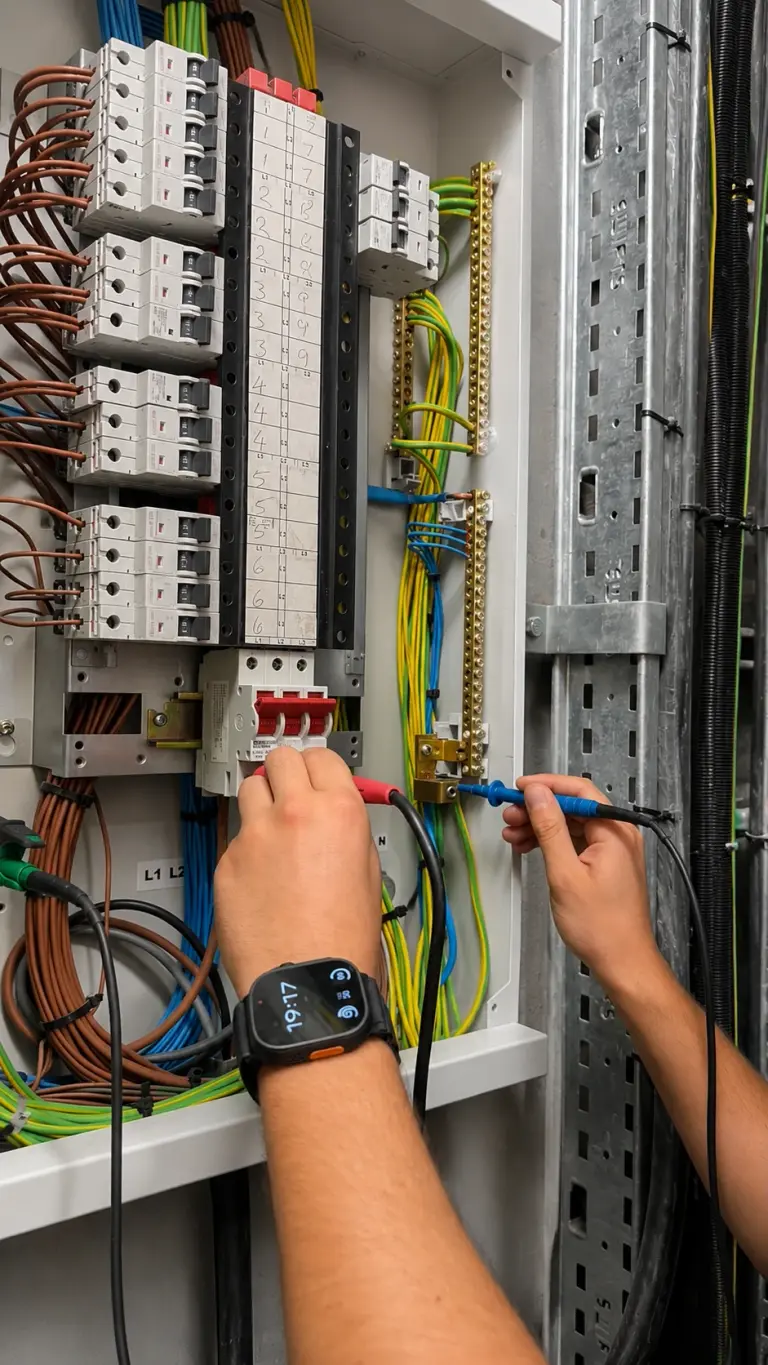
Systematic electrical fault investigation for commercial and industrial premises — diagnosis and clearance of tripping circuits, earth faults, insulation failures and nuisance RCD operation, with a written fault report at completion.
What electrical fault finding actually requires
01
A circuit that keeps tripping with no obvious cause
Intermittent or unexplained tripping is one of the most time-consuming faults to diagnose — particularly when it's caused by a developing insulation failure rather than a hard fault. We use systematic measurement and isolation to locate the fault source, not trial and error.
02
RCDs tripping with no identifiable faulty appliance
Nuisance RCD tripping is often caused by accumulated leakage current across multiple circuits rather than a single faulty appliance. We measure individual circuit leakage currents to identify the contributing circuits and determine whether the cause is equipment, wiring or a combined effect.
03
An earth fault you can't locate on a live site
Earth fault location on a live industrial installation requires a structured approach to isolation — minimising the supply interruption while systematically excluding sections of the installation until the fault location is confirmed.
04
No written record of the fault and repair
For insurance, EICR compliance and maintenance records, a written fault report describing the fault, its cause and the remedial action is required. We provide this as standard at the close of every fault investigation.
Technical detail
Standards & methods
- BS 7671 18th Edition — fault investigation methodology
- IET Guidance Note 3 — insulation testing
- Earth fault loop impedance measurement
- Insulation resistance measurement by circuit
- Thermal imaging for hot-spot identification
Common fault types
- Overcurrent — overloaded circuits and short circuits
- Earth faults — line-to-earth insulation failure
- Nuisance RCD tripping — leakage current accumulation
- Neutral open-circuit — intermittent supply faults
- High-resistance connections — joints and terminals
Test equipment
- Multifunction test instrument (loop, insulation, continuity)
- Thermal imaging camera for non-invasive hot-spot location
- Clamp-on leakage current measurement
- Power quality analyser on request
- Time-domain reflectometry (TDR) for cable fault location
Fault report
- Written fault investigation report
- Fault description, location and cause
- Remedial action taken and test results after repair
- Recommendations for preventing recurrence
- Photographic record of fault location and repair
The Numbers
1st
We aim to locate and clear every fault on the first visit — with the systematic methodology and test equipment to achieve this on all but the most complex intermittent faults.
100%
Every fault investigation closes with a written report covering cause, location, remedial action and post-repair test results.
24hr
We maintain a response capability for urgent electrical fault investigations where the fault is causing a safety risk or operational disruption.
Why specify Con-Tec
Found, Fixed and Documented
Our Fault Finding Approach
01
Fault Description & Review
We review the fault symptoms, circuit history and any available test data before attending site — so the investigation begins with the most likely fault paths already identified.
02
Systematic Investigation
Isolation, measurement and exclusion carried out in a structured sequence — identifying the fault location with the minimum supply interruption.
03
Fault Clearance
Remedial works carried out on the same visit where possible, with the circuit restored and verified by test before handover.
04
Fault Report
Written fault investigation report covering cause, location, remedial action and post-repair test results submitted within 24 hours of completion.




1 / 4
What our clients say
“Just a note to say that John and his team from Con-Tec Solutions have produced another outstanding performance on the refit of lighting in the atrium at BCW. Work carried out was done at an extremely high standard. All relevant risk assessments and method statements brought to site and adhered to. These guys really do set the standards that we should be expecting from all our contractors.”
Grant Metcalf, Eric Wright Facilities Management
Get a Quote
Ready to Start a Project?
Our team is on hand to discuss your commercial or industrial electrical requirements. Share your project details with us, and we’ll be in touch to discuss the scope, programme and a tailored, cost-effective solution.